The second anniversary of the Cannabis Act thus marks not only an important political milestone but also the right time for an objective interim assessment. The results confirm key assumptions of the debate to date: The illicit market has already been partially pushed back without leading to a sharp rise in consumption. While consumption among adults remains largely stable and shows no increase among adolescents, and in some cases even a decline, demand is gradually shifting toward legal sources. At the same time, these legal channels of access, particularly in the non-medical sector, remain structurally limited.
Development of Comprehensive Cannabis Law
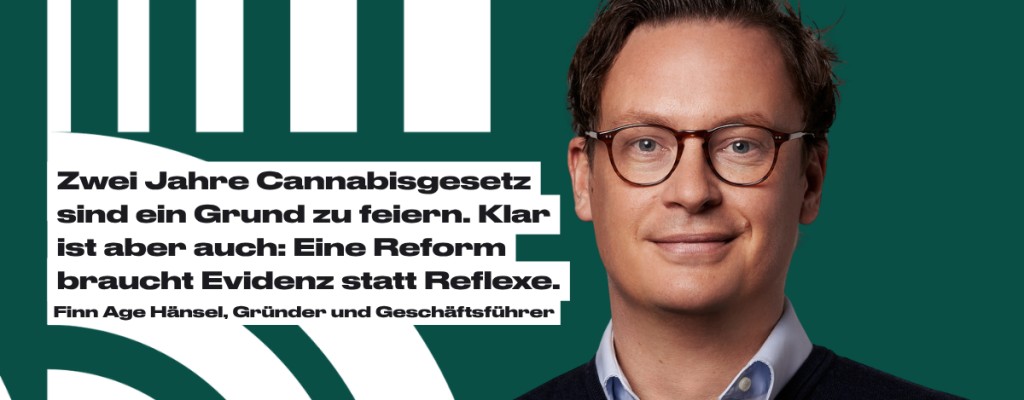
Two years after the Cannabis Act came into effect, it has become clear that the regulatory frameworks of the Medical Cannabis Act (MedCanG) and the Act on the Handling of Cannabis for Non-Medical Use (KCanG) cannot be viewed in isolation from one another. The new EKOCAN findings highlight the close interplay between medical care and the recreational market. On the one hand, the report shows that the medical market fulfills an important supply function and contributes to reducing illegal sources of supply, but at the same time it draws attention to existing structural challenges. “The data clearly show: The market does not function in separate segments, but rather in mutual interdependence,” explains Finn Hänsel. “When legal access is restricted, demand does not disappear. It shifts back to the illegal market, with negative consequences for public health, product quality, and the containment of illegal structures.”
Against the context of a planned amendment to the MedCanG, Sanity Group is therefore warning against hasty and indiscriminate interventions. At the same time, existing legal channels of access for consumers have not yet sufficiently covered demand. In 2025, only a maximum of 3.5% of consumers were able to obtain cannabis through cultivation associations; nationwide, only 366 cultivation associations were approved. Meanwhile, the proportion of consumers who primarily grow their own cannabis rose from 5.4% (2024) to 21.4% (2025). At the same time, however, illegal procurement through social contacts (“social supply”) remains the most common source at 35.2%.
Sanity Group advocates for evidence-based refinement of the existing legal framework that addresses both areas simultaneously. The goal must be to expand legal access channels for recreational use while ensuring patient-centered and comprehensive access to medical cannabis. A key component of this approach is scientifically designed pilot projects for the controlled distribution of recreational cannabis through specialized retail outlets. Corresponding applications have already been submitted to the Federal Office for Agriculture and Food (BLE).
Waiting for the Final Report
The evaluation commissioned by the Federal Ministry of Health is being conducted by an
interdisciplinary research consortium consisting of the Center for Interdisciplinary Addiction Research
(ZIS) of the University of Hamburg, the Institute of Criminology at the University of Tübingen, and the
Centre for Health and Society at Heinrich Heine University Düsseldorf. The publication of the second
interim report is part of a multi-year evaluation process. Further steps include the consolidation of all
results into a final synthesis, as well as additional scientific publications and a conference in 2027. The
final evaluation report is scheduled for 2028.
“Two years after the Cannabis Act took effect, one thing is obvious: the reform deserves a serious,
scientifically based evaluation, not a rushed political change of course,” said Finn Hänsel. “As agreed in
the coalition agreement, we should wait for the full evaluation to be completed before drawing farreaching
conclusions or imposing new restrictions.”
About Sanity Group
Sanity Group aims to improve people’s quality of life through the use of cannabinoids and the utilization of the endocannabinoid system. The focus is on cannabinoid-based pharmaceuticals and consumer goods. To harness the full potential of cannabis, Sanity Group invests in research of the cannabis plant and its active ingredients as well as in specific areas of application. Sanity Group, founded in Berlin in 2018 by Finn Age Hänsel, includes Vayamed, avaay Medical and ZOIKS (medical cannabis), Endosane Pharmaceuticals (finished pharmaceuticals), vaay (lifestyle) and Grashaus Projects (recreational cannabis Swiss pilot project). Near Frankfurt am Main, Sanity Group also operates a logistics and production facility for cannabis pharmaceuticals. More information at sanitygroup.com/press.
Pressekontakt

Jennifer Plankenbühler
Pressesprecherin | Lead Medical PR
E-Mail: jennifer.plankenbuhler@sanitygroup.com | presse@sanitygroup.com
Phone: +49 (0) 173 37 62 845