Categories
Sanity Group

Two Years of Legal Cannabis from Specialized Retail Stores: Swiss Pilot Project Shows Positive Effects on Health Protection, Consumer Competence, and Combating the Illicit Market

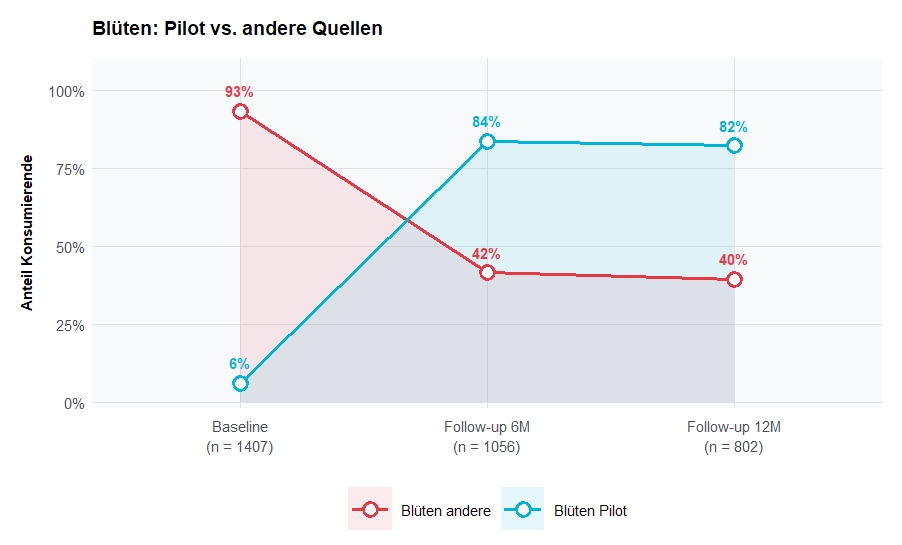
One of the most compelling results after two years concerns the potential displacement of the illicit market. Among the more than 1,600 current study participants, parallel sourcing of cannabis from other channels has declined significantly. Whereas before entering the study cannabis was obtained from the illicit market on an average of about 20 days per month, this figure has roughly halved over the course of participation. At the same time, many participants now rely exclusively or predominantly on the legally supplied study products from the specialty stores – sometimes even involving longer travel times, despite other sources being easier for many to access. “This development is highly relevant from the perspective of health and consumer protection,” says Prof. Dr. Michael Schaub, Scientific Director at ISGF and head of the study. “It suggests that consumers are willing to leave the illicit market when they have access to quality-tested products from controlled sources and to reliable information.”
Professional Counseling as a Reliable Source of Information
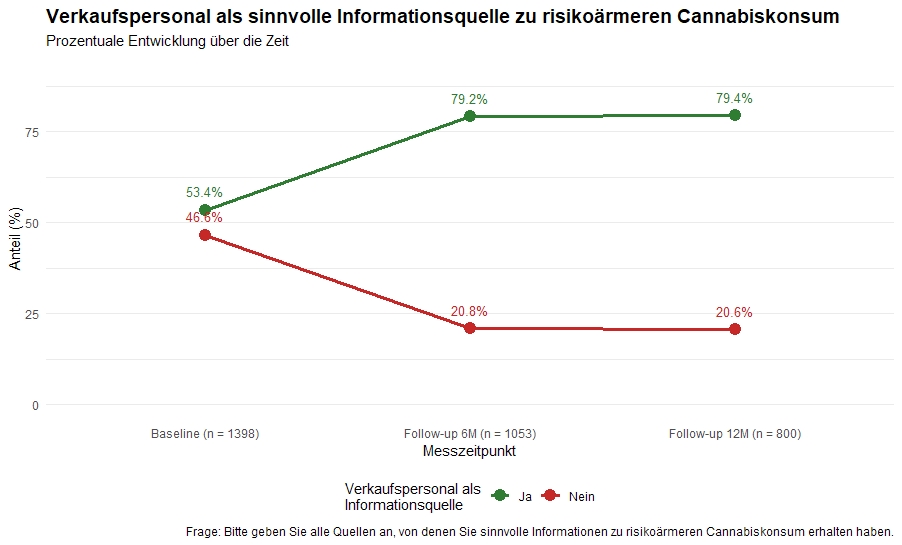
Professional counseling in the specialty stores is also becoming increasingly important for participants. The trained sales staff – so-called “budtenders” – are viewed as a useful source of information on lower-risk cannabis use by a majority of participants. Many subjects report having adjusted their consumption behavior following counseling sessions, for example with regard to dosage, THC content, product choice, or method of consumption. “We see a clear link here between a regulated setting, counseling, and responsible consumption,” Schaub adds. “This central element is, of course, completely absent from the illegal market.” 
Safer Use: Harm-Reducing Accessories and Lower-Risk Consumption Methods
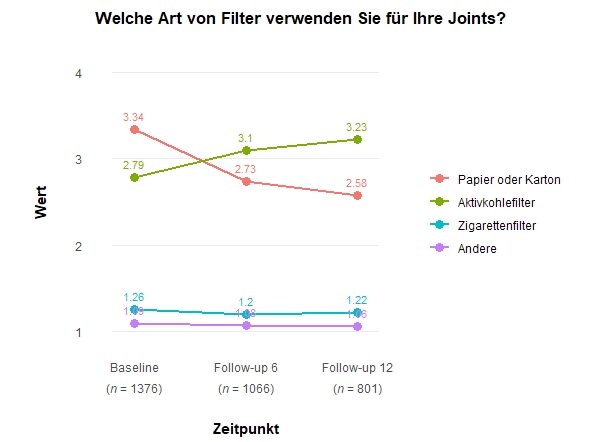
Changes in consumption behavior can also be observed in terms of harm reduction. Particularly striking is the increase in the use of activated charcoal filters, which can reduce health risks of smoking more effectively than conventional cigarette filters, paper, or cardboard. The growing spread of such “safer use” practices indicates that consumers in a legal framework are more receptive to health education and risk-reduction measures. Positive trends can also be observed with regard to consumption methods: over time, study participants are increasingly engaging with less harmful options such as edibles, drops, or vaporizers.
“Germany Is Taking the Opposite Path”
For Finn Hänsel, founder and CEO of Sanity Group, the results send a clear message to policymakers in both Switzerland and Germany: “While in Switzerland we can now see that regulated specialty stores can help strengthen health protection and effectively curb the illicit market, pilot projects in Germany – such as those proposed in Frankfurt am Main, Hanover, or Berlin – have recently been rejected. Germany is taking the opposite path and, in our view, the wrong one. Anyone who truly wants to achieve legalization goals such as comprehensive health protection and sustainable suppression of the illicit market must be willing to test them scientifically, rather than foregoing evidence for ideological reasons.”

Switzerland, by contrast, continues to consistently prioritize evidence generation. “Switzerland understands that sensible regulation has to be adaptive,” says Leonhard Friedrich, Managing Director of Sanity Group Switzerland. “Pilot projects like this provide the data basis for a realistic, responsible cannabis policy. After two years, we can draw an entirely positive interim assessment and remain in close dialogue with the authorities. It is encouraging that the evidence being generated here can make a meaningful contribution to legislation.”

In Germany, comparable evidence is still nowhere in sight, according to Finn Hänsel: “Without corresponding model projects, such important data and insights will continue to be lacking.”

+++

Source of figures (unaltered): Swiss Research Institute for Public Health and Addiction (ISGF)
 

About Sanity Group
Sanity Group aims to improve people’s quality of life through the use of cannabinoids and the utilization of the endocannabinoid system. The focus is on cannabinoid-based pharmaceuticals and consumer goods. To harness the full potential of cannabis, Sanity Group invests in research of the cannabis plant and its active ingredients as well as in specific areas of application. Sanity Group, founded in Berlin in 2018 by Finn Age Hänsel, includes Vayamed, avaay Medical and ZOIKS (medical cannabis), Endosane Pharmaceuticals (finished pharmaceuticals), vaay (lifestyle) and Grashaus Projects (recreational cannabis Swiss pilot project). Near Frankfurt am Main, Sanity Group also operates a logistics and production facility for cannabis pharmaceuticals. More information at sanitygroup.com/press.

Pressekontakt

Jennifer Plankenbühler

Pressesprecherin | Lead Medical PR

E-Mail: jennifer.plankenbuhler@sanitygroup.com | presse@sanitygroup.com

Phone: +49 (0) 173 37 62 845

Categories
Sanity Group

Research application initially rejected: Scientific pilot project on recreational cannabis in Frankfurt and Hanover denied regulatory approval

The project partners – comprising the scientific leads Prof. Dr. med. Kirsten Müller-Vahl (Medizinische Hochschule Hannover) and Prof. Dr. Heino Stöver (formerly Frankfurt University of Applied Sciences), as well as Sanity Group – disagree with the authority’s legal assessment: “We subjected the legal foundations of the research application to particularly thorough legal scrutiny and additionally secured them with an external legal report. It concluded that the research clause of Pillar 1 of the KCanG indeed provides a legal basis for scientifically designed pilot projects on recreational cannabis,” said Finn Hänsel, founder and CEO of Sanity Group. The report was made available to the authority during the review process.

Telemedicine debate makes legal alternatives more urgent
Sanity Group also views the BLE’s decision critically in light of current health policy developments. Ongoing discussions about stricter regulation of specialized telemedicine platforms in the medical cannabis sector threaten to cut off legal access for many people through the medical market. “We of course consider it the right step to make telemedical services available only to patients with serious health conditions. But if this area is more strictly regulated, there is an urgent need for legal alternatives. Otherwise, consumers who have so far at least obtained quality-assured products through the medical system instead of through illegal channels will be forced back into the illicit market – and thus back to unpredictable health risks,” Hänsel continued.

Such an outcome would run counter to the objectives of the Cannabis Act, which explicitly aims to strengthen health and youth protection while curbing the illicit market. “Pilot projects like those in Hanover and Frankfurt offer the chance to test scientifically sound and sensible solutions precisely for this need. This would create a clear separation between recreational use and medical therapy, provide a comprehensive data basis, and significantly relieve the medical care system.”

Looking to Switzerland underscores potential
The planned pilot projects were intended to scientifically study and evaluate, for the first time in Germany, the legal distribution of recreational cannabis in licensed specialty stores. The goal was to generate data for evidence-based regulation, similar to Switzerland, where comparable pilot projects have been providing valuable insights into consumption behavior, prevention, and illicit-market reduction since 2023.

“Home cultivation and cannabis clubs alone cannot meet demand in Germany; they are simply insufficient as legal sources of supply. Together with our partners, we will therefore continue to advocate that cannabis consumers are not once again left to the illegal market,” Hänsel emphasized. “And international experience proves us right: scientifically monitored pilot projects are the right path to combine health protection and consumer safety with effective illicit-market reduction.”

Health protection and illicit-market reduction: central research questions
In the study planned for Hanover and Frankfurt, registered adult participants were to be granted legal access to cannabis flowers and other THC-containing products at real market prices over a five-year period. The aim of the project was to investigate the effects of regulated cannabis distribution for recreational purposes – for example, on consumer health, youth protection, the illegal market, and organized crime. The project’s results could enable an evidence-based evaluation and provide a foundation for further decisions regarding cannabis legalization legislation.

EKOCAN evaluation results: pioneering insights
On Monday, initial interim results of the accompanying evaluation of KCanG were presented at a federal press conference, carried out by the joint research project “EKOCAN.” A key finding of the report: As of April 2025, production by cannabis cultivation associations covered less than 0.1 percent of total demand in Germany. Another reason, Hänsel argued, to make scientifically monitored pilot projects for specialized retail outlets possible. He views the publication of these interim results as an important opportunity to reinforce the case for pilot projects: “The findings strengthen our call for supplementary, scientifically monitored distribution models. It remains to be seen whether the results will also serve as a basis for adjustments to the KCanG or for the potential approval of pilot projects.”


About Sanity Group
Sanity Group aims to improve people’s quality of life through the use of cannabinoids and the utilization of the endocannabinoid system. The focus is on cannabinoid-based pharmaceuticals and consumer goods. To harness the full potential of cannabis, Sanity Group invests in research of the cannabis plant and its active ingredients as well as in specific areas of application. Sanity Group, founded in Berlin in 2018 by Finn Age Hänsel, includes Vayamed, avaay Medical and ZOIKS (medical cannabis), Endosane Pharmaceuticals (finished pharmaceuticals), vaay (lifestyle) and Grashaus Projects (recreational cannabis Swiss pilot project). Near Frankfurt am Main, Sanity Group also operates a logistics and production facility for cannabis pharmaceuticals. More information at sanitygroup.com/press.

Pressekontakt

Jennifer Plankenbühler

Pressesprecherin | Lead Medical PR

E-Mail: jennifer.plankenbuhler@sanitygroup.com | presse@sanitygroup.com

Phone: +49 (0) 173 37 62 845

Sanity Group signs Strategic Transaction with Organigram
NEWS

Sanity Group has entered into a strategic transaction agreement to become part of Organigram Global, our longstanding investor.

This transaction brings together two highly complementary businesses: Sanity Group’s Europe-focused platform, brands, and market expertise with Organigram’s scale and strong cultivation and R&D capabilities. Together, we aim to build a stronger platform for international growth in regulated cannabis markets.

Organigram Global Logo